
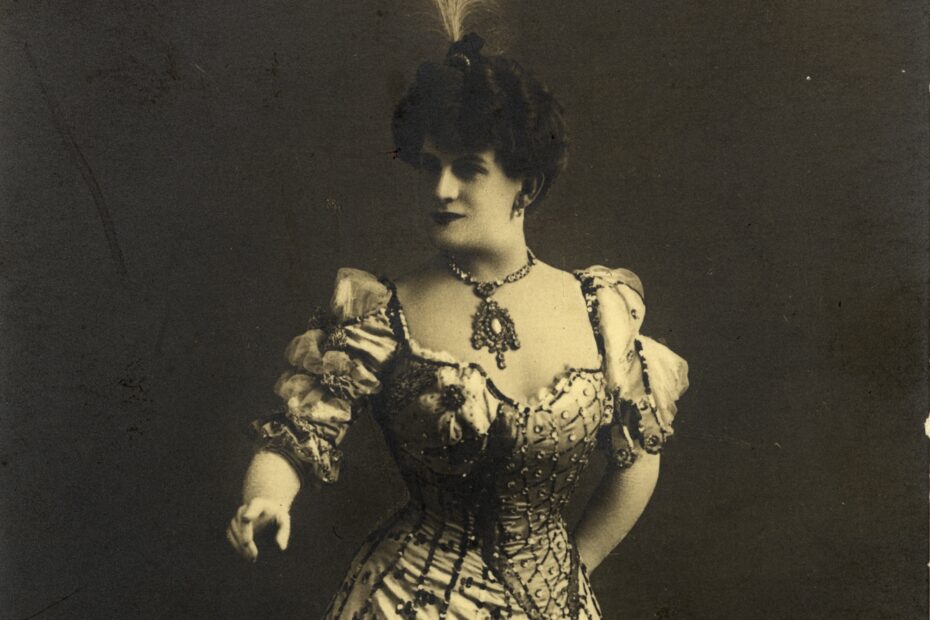
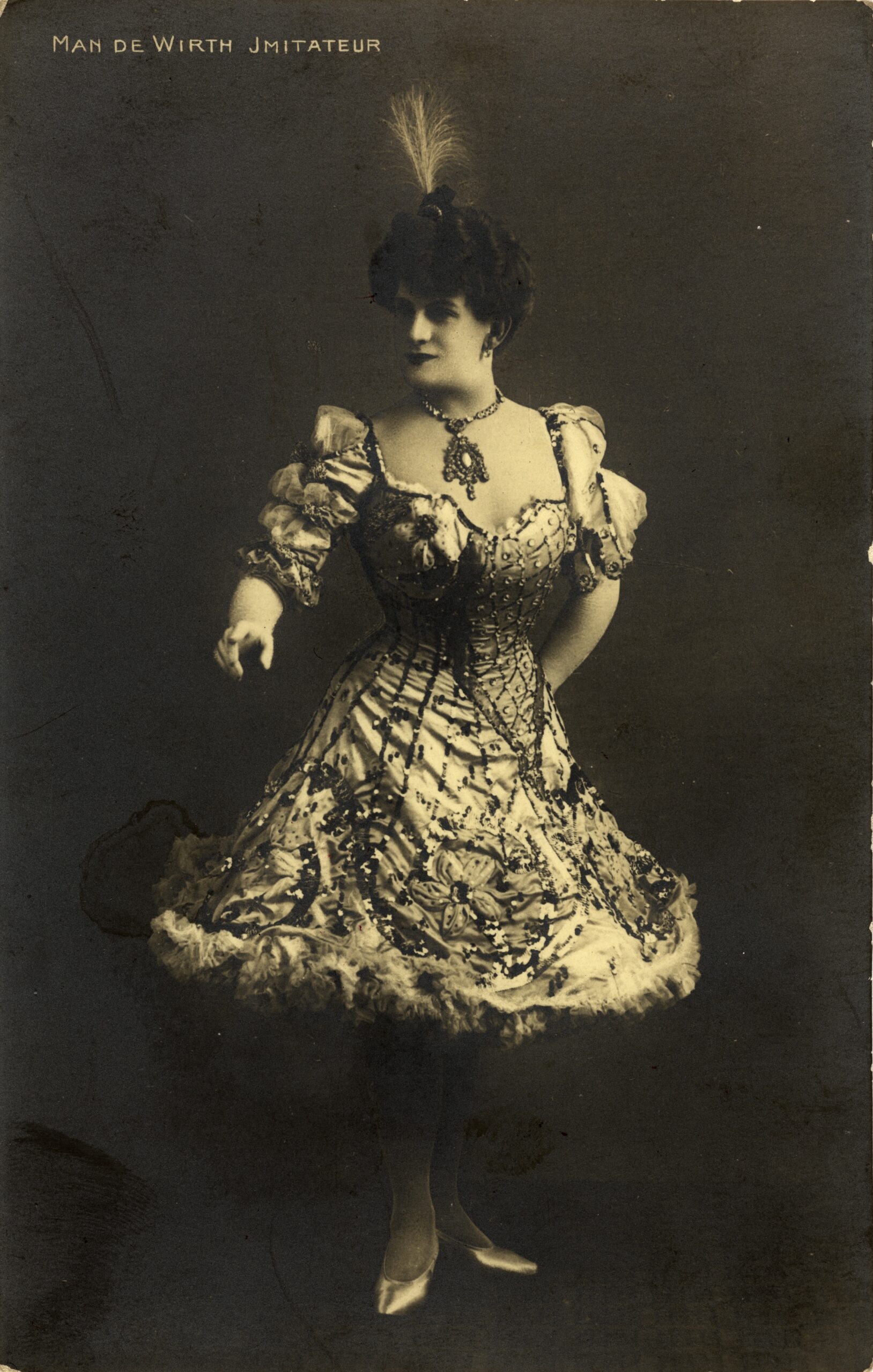
In the picture, you can see Man De Wirth, a very popular female impersonator who
toured both Europe and North America. He first visited Malmö in 1887. His career
continued until the 1930s, when he died in a car accident on the Reeperbahn in
Hamburg. (Stadtmuseum Berlin)
The decades between 1880 and 1910 were both the heyday of male and female impersonators and a period when queer communities were emerging in Malmö. There were more than 500 advertised performances, and probably many more in less formal settings. In the newspapers, 20 female impersonators and three male impersonators have been found. The genre was introduced in Sweden and Malmö during the 1880s by foreign performers appearing at the more exclusive entertainment venues. From the 1890s onwards, however, more and more artists from Malmö and elsewhere in Sweden took to the stage in cross-dress. Over time, impersonators also performed on a wider variety of stages–for example, at events organized by the temperance movement and the labor movement, at Malmö Tivoli, and, towards the end of the period, as intermission acts in cinemas. The genre became increasingly popular, with cheaper tickets and sometimes even free admission. There were also performances specifically for children. In short, by the first decade of the twentieth century, virtually everyone in the city, regardless of age or financial means, could see male and female impersonation if they wished.
This growing visibility of gender impersonation on Malmö’s stages coincided with a broader change in how same-sex desire and gender-nonconforming expressions and identities were understood. During this period, homosexuality increasingly emerged as a framework for making sense of same-sex attraction and gender nonconformity. Gender-nonconforming expressions and identities, in turn, increasingly came to be associated with homosexuality. Through convincing impersonations combined with risqué humor, male and female impersonators who played with gender boundaries thus had the opportunity to communicate homosexual identities from the stage.
The source material shows that at least three of the impersonators had same-sex relationships, while several others left indications pointing towards queer life experiences. Although firm conclusions are rarely possible, the material suggests that male and female impersonators not only challenged contemporary ideas about gender from the stage, but that several of them may also have been part of the emerging queer communities in Malmö.
The genre’s move to new stages was driven not only by growing public interest, but also by the so-called Variety Show Prohibition of 1896, a law that prohibited the serving of alcohol in connection with variety performances. This meant that performers had fewer opportunities to work and were paid less at variety venues, forcing them to seek out alternative stages. Swedish male and female impersonators also increasingly began to seek opportunities abroad, including in Finland.
In which Finnish cities were there Swedish male or female impersonators performing during this period?
Linus Sollin
The author is an archivist at the Malmö City Archives. Over the past few years, he has been researching male and female impersonators and their connections to the emergence of queer communities in Malmö between 1880 and 1910.
References
Laine, Mio. 2025. ”Lieneekö tuo aprillinarrio wai pitkälle kehittyneen emansipatsioonin merkkiä wai muuta wallattomuutta.” : Sukupuolen ilmaisun moninaisuus suomalaisissa sanomalehdissä 1868–1917. Pro gradu thesis, University of Turku.
Sollin, Linus. 2026. “När damimitatör Carl Friedlew hade gått och lagt sig: Ett imaginärt scenario baserat på reparativ läsning av historiska källor.” Ale 1.
Sollin, Linus. 2026 forthcoming. “‘Ett storartat uppseendeväckande afklädningsnummer’: Dam- och herrimitatörer och queera gemenskaper i Malmö 1880–1910.” RIG – kulturhistorisk tidskrift 109 (4).
Stryker, Susan. 2017. Transgender history the roots of today´s revolution, New York: Seal press.
Ullman, Sharon R. 1995. ”The Twentieth Century Way”: Female Impersonation and Sexual Practice in Turn-of-the-Century America” Journal of the History of Sexuality. Vol.5 no. 4 (573-600). Chicago: University of Chicago Press.

Sateenkaarihistorian ystävien kirjoituksia on verkkolehti, jota Sateenkaarihistorian ystävät ry julkaisee osoitteessa sateenkaarihistoria.fi/verkkolehti.
ISSN 2737-3908